
Short answer: Here’s how to push back on an unrealistic deadline from your boss: don’t refuse in the room. Say yes to the goal and promise an answer by a set time. Then break the work into tasks and days, close what gap you can yourself, and come back within a day with the math, three options (move the date, cut the scope, or add people), and the one you recommend.
Most people handle an unrealistic deadline in one of two ways. They say “That’s impossible” on the spot, and the meeting turns into an argument about their attitude instead of the work. Or they say “Sure” and hope, and the real conversation happens two days before the deadline, when nothing can be fixed anymore.
A typical case: a team is handed a launch date that’s three weeks too short. Nobody says anything. They work late, cut testing quietly, and keep reporting “on track.” A week before launch it’s clear the date will slip anyway, now with a quality problem on top. The boss’s first reaction isn’t “Why is this late?” It’s “Why didn’t anyone tell me when there was still time?”
The fix is neither refusing nor silently accepting. It’s a yes now, and a recalculated yes soon after.
Table of Contents
Should you refuse an unrealistic deadline on the spot?
Usually not. A sudden deadline often comes with context you don’t have yet: a client commitment, a board date, a problem above your boss’s level. Refusing in the room puts both of you on the defensive, and decisions made in that mood tend to age badly.
What you agree to in the room is the goal, not the date: “Understood. Let me map out what it takes and come back to you by 4 p.m.” That buys you a few hours, shows you’re taking it seriously, and gives you time to find out whether the deadline is really impossible or just uncomfortable.
How to push back on an unrealistic deadline: the Recalculated Yes
The Recalculated Yes is a simple rule: say yes to the goal, then answer the deadline with numbers, not feelings. It has four steps.
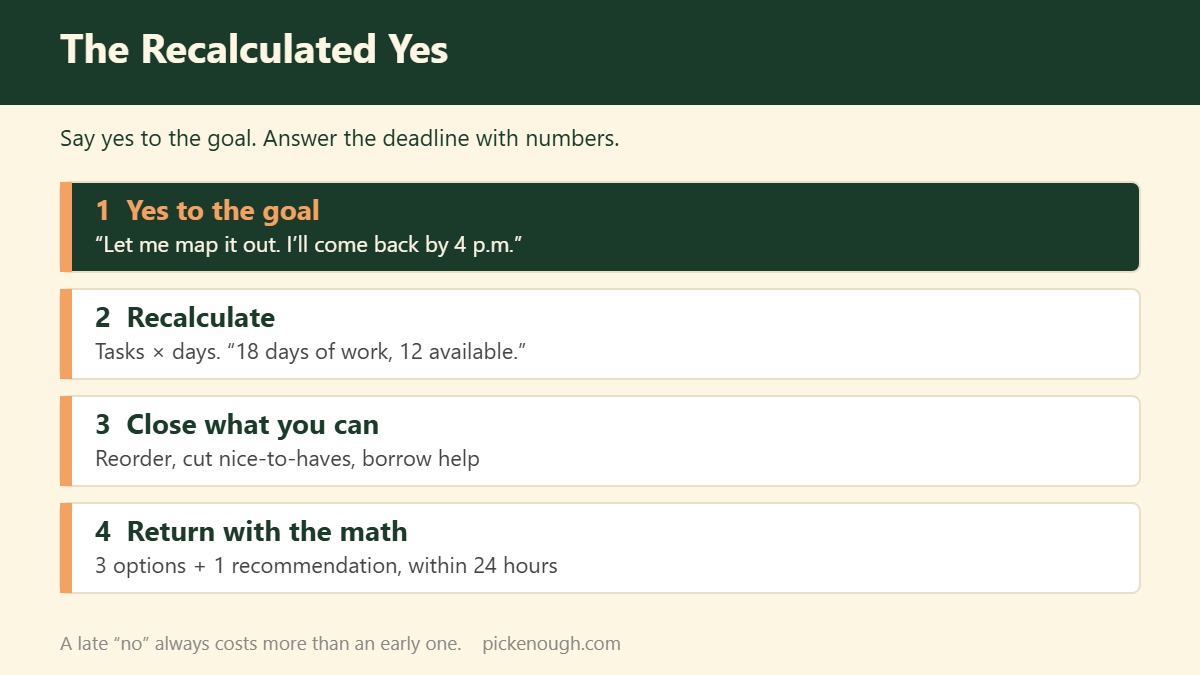
1. Say yes to the goal, and set a time to come back
Acknowledge the request and name when you’ll respond, ideally the same day and never later than 24 hours. Ask one question if you can: “Is the date fixed by something outside the team?” The answer tells you which levers will be open later.
2. Recalculate the work
Back at your desk, break the job into tasks, estimate each in days, and mark the dependencies on other people. Add it up against the working days you actually have. Now “impossible” becomes a specific number: “We need 18 working days and have 12.” If the plan has risks nobody has said out loud, a ten-minute pre-mortem will surface them before you commit to a date.
3. Close what gap you can yourself
Before you go back, try to make it fit: reorder work, drop nice-to-haves, borrow help you can arrange on your own. If the gap closes, you’ve just turned a scary deadline into a plan, and you report the plan. Pushing back is for the gap that’s left. Deciding what is good enough for this date is a skill in itself; I cover it in why good-enough decisions beat perfect ones.
4. If it still doesn’t fit, come back with the math and three options
If the work is physically impossible or the trade-off is unreasonable, go back to your boss with the numbers and a choice, not a complaint:
- Move the date: “The full scope is realistic by the 28th.”
- Cut the scope: “By the 20th we can ship A and B; C follows a week later.”
- Add people: “The 20th works if we get one more person for two weeks.”
Then say which one you recommend and why. You’re not saying no. You’re handing your boss a decision they can make in one reply. If the decision is above your boss’s level, offer to take it up together, the way I describe in how to escalate an issue without going over your boss’s head.
How to tell your boss a deadline is unrealistic: message template (copy and paste)
Send this after the recalculation, the same day if you can.
Subject: [Project] by [date]: the math and 3 options

Hi [Boss],

Thanks for the brief this morning. I mapped out what it takes to deliver [project] by [date].

The math: [X] working days of work, [Y] days available.
What I’ve already adjusted: [moved / cut / borrowed]
The gap that’s left: [Z] days

Three ways to close it:
1. Move the date to [new date] (full scope)
2. Keep [date], deliver [A and B] first, [C] by [later date]
3. Keep [date] and full scope with [one extra person] for [period]

My recommendation: option [#], because [one reason].

Happy to walk through the breakdown if useful. Could you confirm by [time/date]
so we can start on the right plan?

[Your name]
What makes a manager accept a deadline change?
From the side of the person who set the deadline, the test is simple: does the request rest on reasonable criteria and a timeline that makes logical sense? Three things pass that test:
- A breakdown, not an adjective. “18 days of work in 12” beats “way too tight.”
- Proof you tried to make it fit. Show what you already moved or cut.
- A recommendation. Options alone push the thinking back up. One recommended option with a reason makes it a quick yes.
A request built like this is hard to refuse, because it isn’t really a refusal. It’s a better plan with the cost written next to it. For a bigger call, structure it like the Pre-Answered Ask. If it needs sign-off beyond your boss, put the options on one page with a decision memo.
Mistakes that make pushing back backfire
- Arguing in the room. You haven’t done the math yet, so it sounds like reluctance, not analysis.
- Waiting too long to come back. A recalculation that arrives a week later is just a delay report.
- Saying “impossible” without numbers. Your boss can’t take a feeling to their boss.
- Offering one option. A single alternative feels like an ultimatum. Three options feel like a decision.
- Accepting and staying quiet. A late “no” always costs more than an early one, because by then the cheap options are gone.
What if you’ve already accepted and it’s slipping?
Then it’s no longer a deadline negotiation; it’s a delay report. Say it early, with the new date first: see how to tell your boss a project is behind schedule. And if you send regular updates, put the risk in the first line with the Verdict-First format.
That’s the whole method for how to push back on an unrealistic deadline from your boss: agree to the goal in the room, do the math outside it, and come back within a day with options instead of objections.
Free: 8 copy-paste templates like the one above (Boss Communication Kit). Get the free kit →
Frequently asked questions
How do you tell your boss a deadline is unrealistic without sounding negative?
Lead with what’s achievable, not with “unrealistic.” Show the work broken into days, what you’ve already adjusted, and three options with a recommendation. Numbers sound like planning; adjectives sound like resistance.
Is it OK to say no to a deadline from your boss?
Rarely on the spot. Agree to the goal in the meeting and come back within a day. If the deadline is still impossible after you’ve recalculated and tried to close the gap, pushing back isn’t just OK, it’s your job, because silence turns into a bigger problem later.
What if my boss says the deadline can’t move?
Then work the other two levers: scope and people. Ask which parts must be ready on the date and which can follow, or what help is available. A fixed date almost always has some flexibility in what gets delivered on it.
How fast should I respond after getting an unrealistic deadline?
The same day if possible, within 24 hours at most. The value of pushing back drops every day you wait, because fewer options are left.
What if the deadline comes from above my boss?
Give your boss the math and the options so they can take it up, and offer to go together. That keeps your boss in the loop instead of going around them.
📬 Pick Enough Weekly
Weekly notes on deciding well and reporting clearly at work.
🎁 Free: the Boss Communication Kit —
8 copy-paste templates for status updates, delays, deadlines, decisions and escalations.