
Short answer: Here’s how to escalate an issue without going over your boss’s head: decide by authority first. If it’s within what you can own, fix it and report after. If it isn’t, go to your boss first with what’s blocked, what you’ve tried, and the one decision you need, and offer to raise it together. Only go higher if they won’t act, and tell them before you do.
Updated November 2026
Most escalations go wrong in one of two ways. Either you wait too long, and the first question you hear is “Why am I only hearing about this now?” Or you go too early, and you’re told “You could have handled this yourself.”
Both are common. A typical case: a scheduling clash with another department drags on for two weeks before anyone raises it, and once it reaches the right desk it’s settled in a day. The opposite happens too: an issue goes up that the person raising it had every authority to fix on their own. The skill isn’t escalating more or less. It’s knowing where your authority ends, and then taking your boss with you instead of going around them.
Table of Contents
When should you escalate an issue instead of handling it yourself?
When the decision is outside your authority. Authority and responsibility come together: if you have the authority to act and you can own the consequences, handle it and report afterward. If the fix needs a decision, budget, or people you don’t control, or the consequence is bigger than you can own, escalate now. Waiting doesn’t shrink the problem. It just shortens the time anyone has to fix it.
A quick test before you decide:
- Can I make this call within my normal authority? If yes, act and report after.
- Could I own the outcome if it goes wrong? If not, it isn’t yours to decide alone.
- Does it need another team, more money, or a new deadline? Those almost always belong above you.
How to escalate an issue without going over your boss’s head: the Authority Line
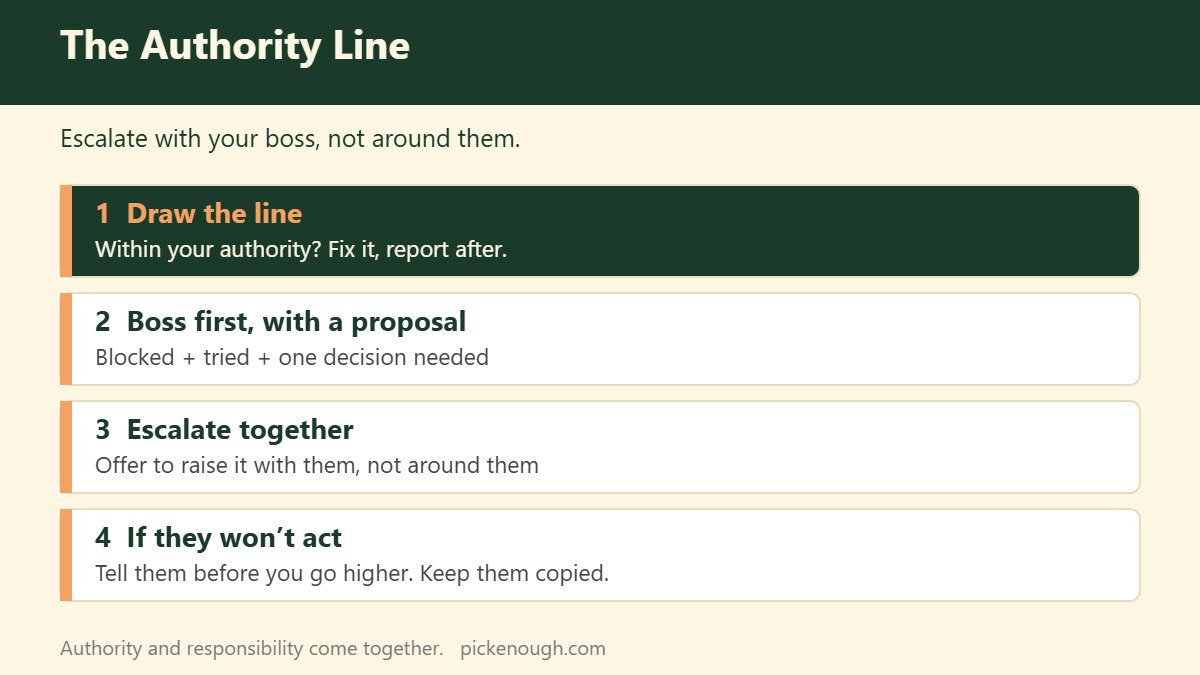
The Authority Line is a simple rule: decide by authority, then escalate with your boss, not around them. It has four steps.
1. Draw the line: yours or theirs?
Use the test above. If it’s within your authority, stop here: fix it, then tell your boss what happened and what you did. That’s a report, not an escalation.
2. Go to your boss first, with a proposal
If it’s above your line, your direct boss hears it first, always. Don’t just hand over the problem. Bring what’s blocked, what you’ve already tried, and the one decision you need. Then offer the next step: “Would you take this to the director, or should we raise it together?”
3. Escalate together, not around
Most of the time your boss will take it up or bring you along. That’s the outcome you want. A skip-level conversation that your boss knows about and supports is not going over their head. It’s escalation with cover.
4. If your boss won’t act, say so before you go higher
If your boss blocks it and the risk is real, don’t go around them quietly. Tell them directly: “I understand you’d rather wait. Because of [the risk], I think leadership needs to know by Friday. I’d like you there, or copied, when I raise it.” Transparency is the difference between escalating and going behind someone’s back.
Escalation email template (copy and paste)
This version is for your boss first. Add your boss’s boss only after step 4.
Subject: Need your help on [issue] by [date]

Hi [Boss],

I need your help with something that's above my authority to decide.

What's blocked: [one or two lines]
Why it matters: [impact — money, deadline, customer, other teams]
What I've tried: [step 1], [step 2]
What I need: [one decision] by [date]

My suggestion: [your proposed fix]

Would you like to take this to [director], or should we raise it together?
Happy to draft the note for leadership.

[Your name]
What makes an escalation easy to say yes to?
Three things, from the side of the person receiving it:
- What’s blocked, in one or two lines.
- What you’ve already tried, so they don’t suggest it back to you.
- The one decision you need from them, with a date.
That’s it. An escalation built this way can often be resolved in a single reply. If the decision itself is big, write it up the way I describe in how to ask your boss to make a decision.
Escalation mistakes that cost you trust
- Problem with no proposal. “We have an issue” and nothing else hands the whole thing upward.
- Blame in the wording. “Team X dropped the ball again” makes the reader defend people instead of fixing the problem. Describe the situation, not the culprit.
- Skipping your direct boss. Even when you’re right, a surprise for your boss damages the relationship more than the issue does.
- Escalating what was yours to fix. It signals you’re not willing to own decisions inside your authority.
- Escalating too late. Leaders forgive a problem far more easily than a surprise.
How this fits with other updates
If the issue is a delay on your own project, the conversation is a little different: see how to tell your boss a project is behind schedule. And if you report regularly, put the escalation in the first lines of your update with the Verdict-First format.
Free: 8 copy-paste templates like the one above (Boss Communication Kit). Get the free kit →
Frequently asked questions
How do you escalate an issue without going over your boss’s head?
Go to your boss first with what’s blocked, what you’ve tried, and the one decision you need, and offer to raise it together. If they refuse and the risk is real, tell them before you go higher and keep them copied.
When should you escalate an issue to senior management?
When the decision is outside your authority: it needs budget, another team, or a new deadline, or the consequence is bigger than you can own. Within your authority, fix it and report afterward.
Is it ever OK to go over your boss’s head?
Only when the risk is serious and your boss won’t act, and you tell them first. A secret escalation damages trust even when you’re right.
How do I write an escalation email?
Keep it short: what’s blocked, why it matters, what you’ve tried, the one decision you need by a date, and your suggested fix. Send it to your boss first.
How do you escalate without sounding like you’re complaining?
Describe the situation, not the person at fault, and always bring a proposal. Facts plus a suggested fix read as ownership, not complaint.
📬 Pick Enough Weekly
Weekly notes on deciding well and reporting clearly at work.
🎁 Free: the Boss Communication Kit —
8 copy-paste templates for status updates, delays, deadlines, decisions and escalations.